
A brighter, natural smile can enhance your appearance without changing what makes you recognisable. Professional tooth whitening is designed to restore clarity and freshness to teeth affected by lifestyle habits, ageing, and everyday staining. The focus is not on creating an unnaturally white or uniform finish, but on achieving a balanced result that looks healthy, believable, and in harmony with your natural features.
Every smile tells a story. Over time, substances such as tea, coffee, red wine, and tobacco gradually influence tooth colour. Even with excellent oral hygiene, pigments from daily consumption settle into the outer enamel and, eventually, the deeper layers of the tooth. Medications, natural enamel thinning, and genetic factors can also contribute to changes in shade. These processes are a normal part of life and do not reflect poor care, yet they can leave teeth looking dull or uneven in colour.
Professional tooth whitening addresses both external and internal discolouration. Surface stains are lifted from the enamel, while deeper pigment changes are broken down within the tooth structure. This dual-action approach gradually and evenly restores brightness, revealing the natural tone beneath accumulated staining. The result is a cleaner, fresher appearance that enhances the smile without stripping it of character.
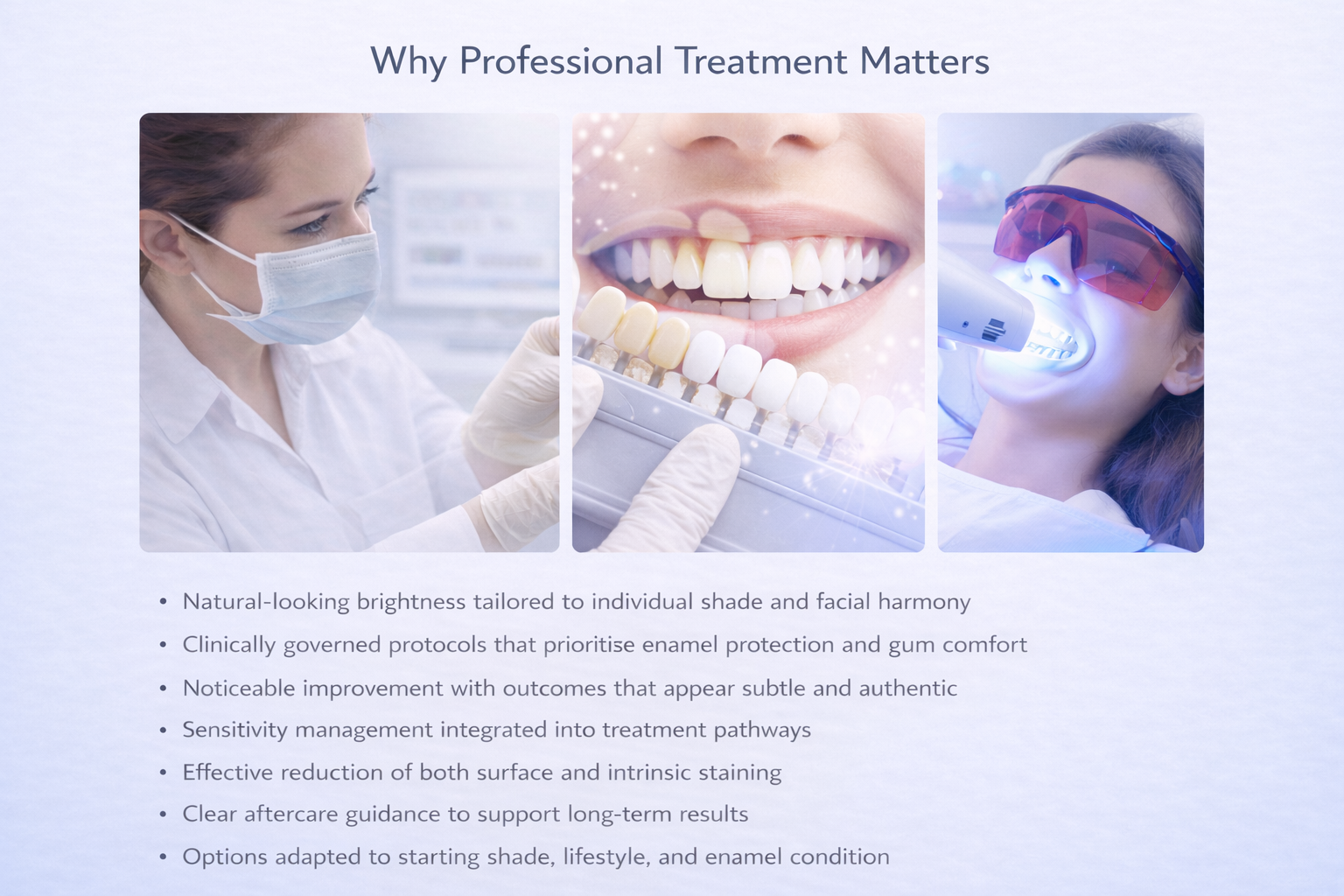
Why Professional Treatment Matters
Preserving enamel integrity is a central priority in professional whitening. Treatments are designed to respect the tooth's natural structure, improving clarity without compromising strength or comfort. Modern whitening approaches focus on controlled, measured enhancement rather than aggressive colour change, supporting both appearance and long-term oral health.
A professionally whitened smile should look effortless. The most successful results are often noticed not because they are strikingly white, but because they appear healthy and cared for. Teeth look brighter, more even in tone, and better aligned with facial features and skin tone. This subtle refinement often leads to increased confidence, whether in social settings, professional environments, or everyday interactions.
Tooth whitening is not a one-size-fits-all process. Individual factors such as starting shade, enamel density, lifestyle habits, and previous dental work all influence the final outcome. Recognising these differences keeps results realistic and tailored, ensuring the improvement feels personal rather than generic.
In the UK, professional tooth whitening has become a trusted option for those seeking a refreshed appearance without invasive cosmetic changes. By focusing on safety, natural aesthetics, and consistency, professional whitening can restore brightness while keeping the smile authentic, expressive, and uniquely yours.
Natural-looking brightness tailored to individual shade and facial harmony
Tooth whitening is most effective when it respects the natural balance of a person's smile. Rather than aiming for an artificial or overly white finish, professional tooth whitening focuses on enhancing the existing tooth colour in a way that complements facial features, skin tone, and age. Every individual has a unique enamel structure and base shade, which means results should be customised rather than standardised. The objective is a cleaner, healthier-looking smile that feels authentic and proportionate, avoiding the stark or unnatural appearance often associated with non-professional whitening methods. This tailored approach ensures that the final result looks refined, confident, and entirely personal.
Clinically governed protocols that prioritise enamel protection and gum comfort
Enamel integrity and gum health are central considerations in professional tooth whitening. Whitening agents interact directly with tooth structure, making controlled application essential. Clinically governed protocols are designed to ensure that whitening is effective without compromising enamel strength or irritating soft tissue. Protective measures help shield the gums during treatment, while carefully formulated whitening solutions work within safe exposure limits. This structured approach reduces the risk of uneven whitening, gum irritation, or long-term sensitivity, ensuring that cosmetic improvement never comes at the expense of oral health.
Noticeable improvement with outcomes that appear subtle and authentic
A successful whitening result should be visible without drawing attention to the treatment itself. Professional tooth whitening aims to lift the shade of the teeth enough to create a fresh, vibrant appearance while preserving natural translucency and character. The improvement is designed to be noticeable to the individual and those around them, yet subtle enough to look effortless. This balance is especially important for people who want to enhance their smile without it appearing altered or exaggerated. The result is often described as looking well-rested, polished, and healthy rather than overtly cosmetic.
Sensitivity management integrated into treatment pathways
Tooth sensitivity is one of the most common concerns associated with whitening, and managing it effectively is a key benefit of professional care. Sensitivity occurs when whitening agents temporarily interact with the microscopic channels within enamel. Modern whitening protocols incorporate desensitising strategies before, during, and after treatment to reduce discomfort. These may include buffered formulations, controlled exposure times, and remineralising steps that help calm the tooth surface. By addressing sensitivity proactively rather than reactively, professional whitening enables comfortable treatment and greater confidence in the process.
Effective reduction of both surface and intrinsic staining
Tooth discolouration develops through a combination of external staining and internal changes. Surface stains are caused by substances such as tea, coffee, red wine, and tobacco, which adhere to the outer enamel layer. Intrinsic staining forms within the tooth structure itself, often as a result of ageing or natural mineral changes. Professional tooth whitening is formulated to address both types of staining simultaneously. By breaking down stain molecules at different depths, whitening treatments achieve a more even and comprehensive colour improvement than surface-level solutions alone. This dual action contributes to longer-lasting and more consistent results.
Clear aftercare guidance to support long-term results
The success of tooth whitening does not end when treatment is complete. Aftercare plays a crucial role in maintaining results and protecting enamel. Professional whitening includes clear, practical aftercare guidance that supports colour stability and oral health. This guidance helps individuals understand how to protect their results during the initial post-treatment period, when teeth may be more receptive to staining, as well as over the long term. Simple, realistic recommendations allow people to maintain their brighter smile without excessive restrictions or complex routines, making results easier to preserve.
Options adapted to starting shade, lifestyle, and enamel condition
No two smiles respond to whitening in the same way. Starting tooth colour, daily habits, and enamel condition all influence how whitening should be approached. Professional tooth whitening takes these variables into account when determining treatment pathways. Individuals with deeper staining may benefit from gradual approaches, while those seeking a quicker refresh may prefer more immediate options. Lifestyle considerations such as dietary habits, smoking history, and sensitivity levels are also factored into treatment planning. This adaptability ensures that whitening remains both effective and appropriate, delivering results that align with personal needs and expectations.
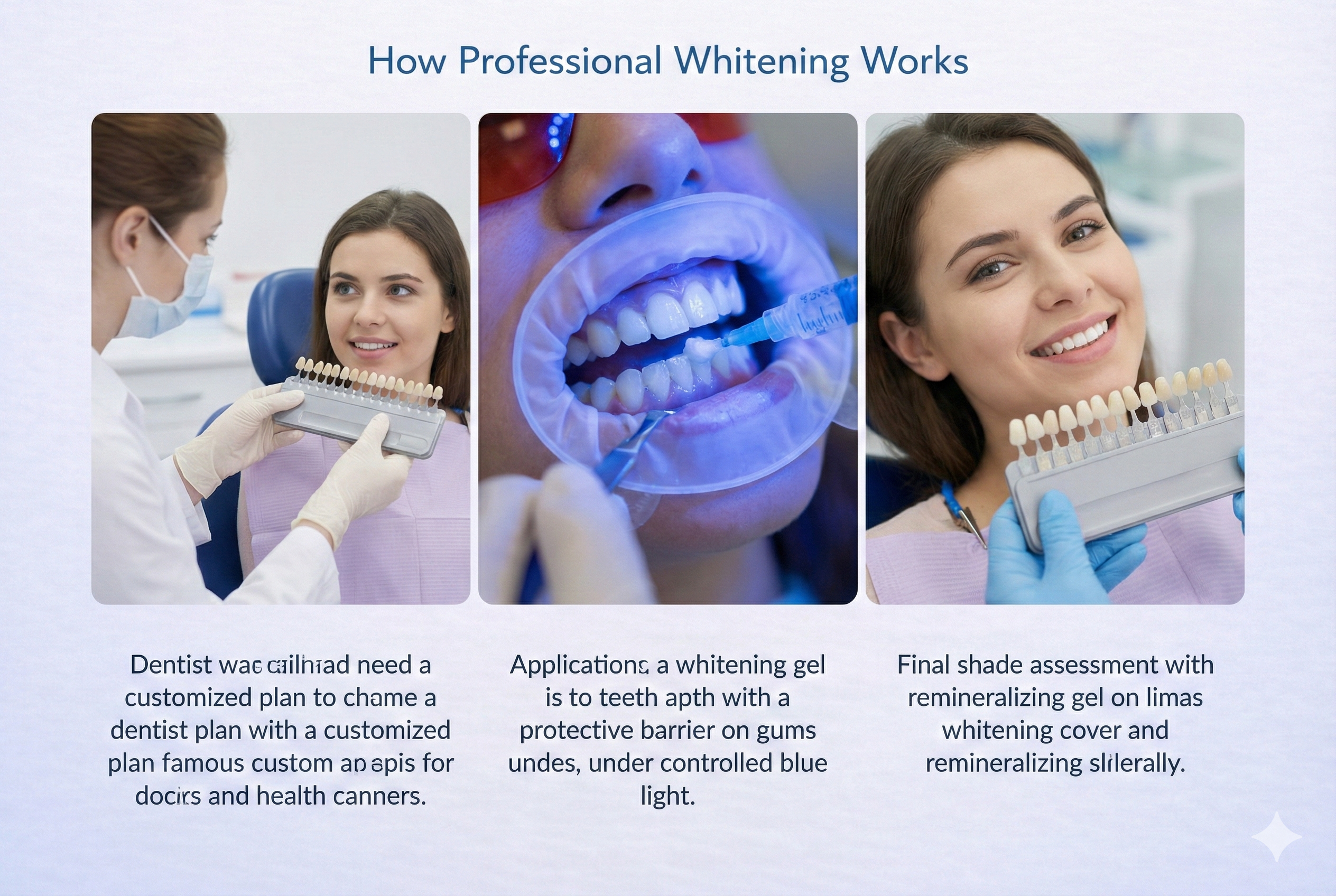
How the Treatment Works

Professional tooth whitening is based on a clinical philosophy of safety, predictability, and natural aesthetics. Each stage is designed to honour the biology of teeth while achieving visible, well-balanced shade enhancements. Instead of generic whitening formulas and one-size-fits-all treatment methods, professional whitening is customised to your specific enamel properties, current dental work, and realistic cosmetic goals.
This begins with a dental examination of your current tooth shade and oral health. Surface staining and internal factors both contribute to tooth colour, and understanding the differences is necessary to set realistic expectations. Enamel thickness, translucency, and mineral density are considered because they affect how whitening agents interact with the tooth. The condition of any pre-existing restorations such as fillings, crowns, or veneers is assessed to ensure colour stability and prevent unintended contrast after treatment.
Following the assessment, a customised whitening plan is formulated. This preparatory phase balances aesthetic desires with biological constraints, resulting in a smile that looks better without sacrificing enamel health. The treatment intensity and exposure duration can be tailored to achieve a balance between effectiveness and comfort. This customised approach allows for shade advancement without the risk of sensitivity.
Whitening agents are applied under controlled conditions. They penetrate the enamel and dentine, where they break down stain molecules into less visible components. The process targets discolouration, not the physical structure of the tooth. Protective measures are used to shield gums and surrounding soft tissues, ensuring comfort and preventing irritation. Exposure is closely monitored to ensure the whitening reaction proceeds safely and effectively.
The controlled application phase is essential to achieving professional whitening results. It ensures contact time and concentration levels are managed in a way that produces noticeable improvement without harming the enamel. This precision sets professional whitening apart from unregulated procedures that may result in uneven shade or unnecessary tooth sensitivity.
After treatment, an assessment is performed to evaluate the degree of shade change and the stability of the result. Teeth are examined for consistency, brightness, and balance with facial structure. Remineralisation techniques, when applicable, can support enamel recovery and fortify tooth structure. Desensitising steps help minimise the risk of temporary sensitivity and contribute to a more comfortable post-treatment experience.
Tooth whitening is evaluated by balance rather than speed or intensity. Each stage works together to provide a naturally radiant smile that remains healthy and strong over time. This systematic approach to whitening is not only efficient, but also conservative, placing cosmetic improvement within the context of overall long-term oral health.
Who Is Suitable
Ideal candidates for tooth whitening are adults with good oral health and sufficient natural tooth tissue suitable for bleaching. Untreated decay, active gum disease, significant enamel erosion, or extensive restorations can influence both suitability and expected outcomes. Modern whitening protocols emphasise conservative exposure, enamel protection, and structured sensitivity management to enhance appearance without compromising dental health.
Pregnancy and breastfeeding are approached with clinical caution. Whitening decisions during these periods are guided by professional assessment and individual circumstances, prioritising overall wellbeing.
Types of Conditions or Concerns Explained
The origin of staining, enamel composition, and previous dental work influence how teeth respond to whitening. Yellow-toned staining generally responds more readily than grey or blue-toned discolouration, which may require more gradual improvement. Because restorations remain unchanged, aesthetic planning focuses on overall balance rather than isolated brightness.
Tooth discolouration develops through external staining and internal changes. Surface stains are caused by substances such as tea, coffee, red wine, and tobacco, which adhere to the outer enamel layer. Intrinsic staining forms within the tooth structure itself, often as a result of ageing or natural mineral changes. Understanding these differences helps set appropriate expectations and treatment plans.
Treatment Options and What to Expect
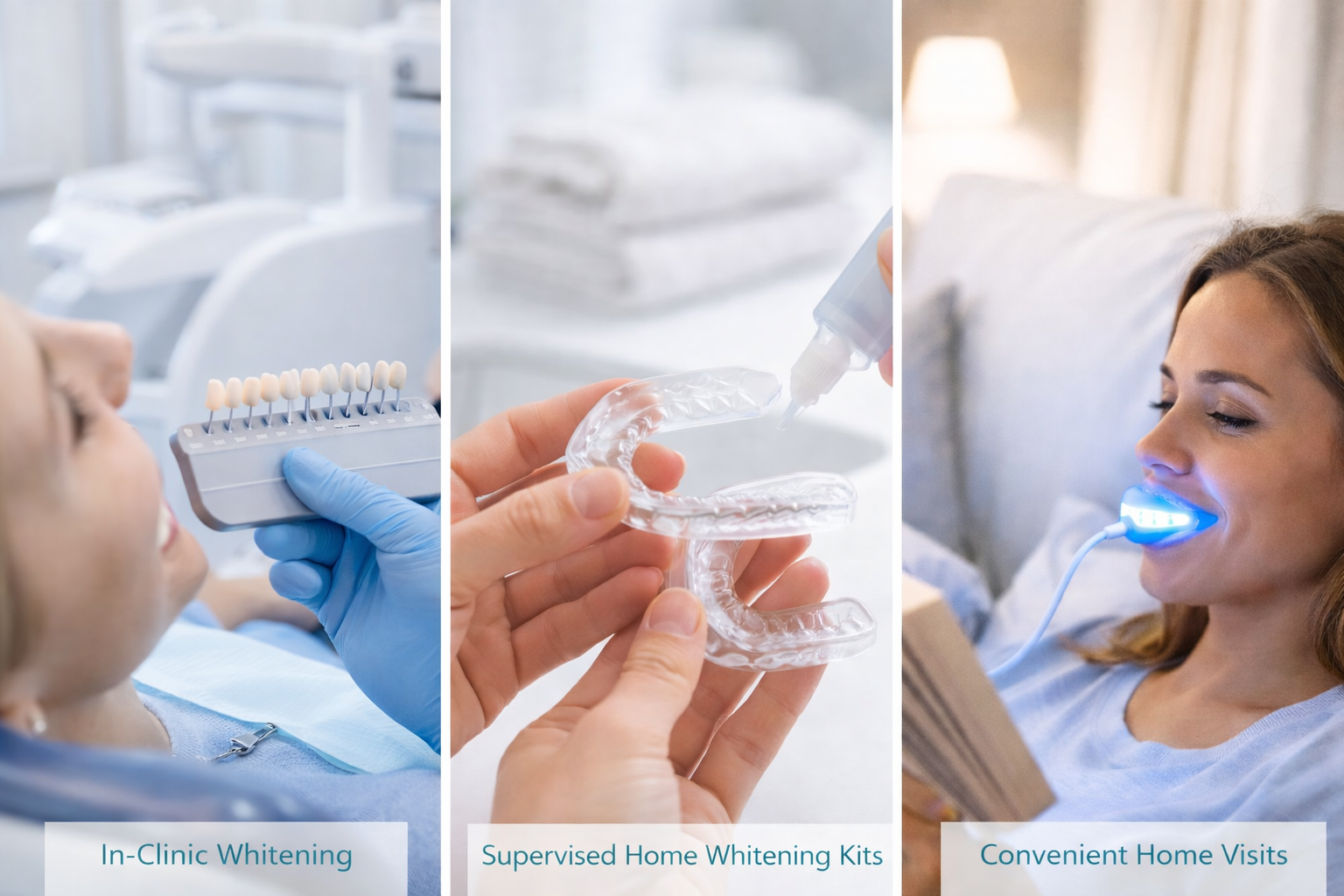
Professional tooth whitening encompasses several clinically recognised approaches, each designed to address different preferences, timelines, and aesthetic goals while maintaining enamel integrity.
In-Clinic Whitening
This is a single-session clinical procedure performed under controlled conditions. Professional-grade whitening formulations are applied with precision and continuously monitored to ensure even coverage and comfort throughout treatment. Protective measures are used to shield surrounding soft tissues, allowing effective stain reduction without compromising gum health. This approach delivers immediate, predictable enhancement while preserving a natural appearance. It is often selected by individuals seeking noticeable improvement within a short timeframe while retaining a balanced, authentic smile.
Clinician-Guided Home Systems
These provide a more gradual pathway to whitening. Custom-fitted trays and prescribed formulations allow controlled lightening over days or weeks, supporting steady shade improvement with minimal disruption to daily routines. This method offers flexibility and encourages long-term maintenance, as incremental progress can be carefully monitored and adjusted. The progressive nature of this option often suits individuals who prefer a slower transition or who are particularly conscious of managing sensitivity while still achieving reliable results.
Over-the-Counter Products
These vary widely in formulation and effectiveness. Many non-professional options offer limited penetration and inconsistent outcomes, particularly for deeper or long-standing stains. Some abrasive formulations may compromise enamel surface smoothness without delivering a meaningful colour change. Professional pathways provide greater predictability, targeted stain reduction, and enhanced enamel preservation through clinically guided protocols.
Realistic Results and Expectations
Whitening outcomes depend on several biological and lifestyle factors, including enamel composition, the origin of discolouration, and the presence of dental restorations. Yellow-based stains typically respond more readily to whitening agents than grey or blue-toned discolouration, which may require a more measured approach. Crowns, veneers, and bonded restorations remain unchanged by bleaching; aesthetic planning considers overall harmony between natural teeth and existing dental work.
The intended result is a refreshed, healthy-looking smile that reflects individual character rather than an artificial or overly bright appearance. Professional whitening aims to enhance what is already present, creating balance and uniformity while respecting natural variation in tooth colour.
The timeline for visible results varies depending on the selected whitening approach. Some professional methods deliver noticeable brightness immediately, while others achieve gradual improvement over several days or weeks. Both approaches aim for natural enhancement rather than abrupt or exaggerated change. The chosen method reflects individual preferences, starting shade, and sensitivity considerations, allowing results to develop in a controlled and balanced way.
Safety and Professional Standards
Professional tooth whitening is built around regulated clinical methods designed to protect both enamel and surrounding soft tissues. Whitening agents are carefully formulated to penetrate the tooth structure without compromising strength or surface integrity. Protective measures are used to shield gums and minimise exposure to surrounding areas, ensuring treatment remains controlled and predictable. When performed using professional protocols, tooth whitening supports aesthetic improvement while maintaining long-term oral health.
Temporary sensitivity is one of the most commonly discussed aspects of tooth whitening, though experiences vary from person to person. Contemporary whitening systems are designed to reduce discomfort through buffered formulations and integrated desensitising components. When sensitivity does occur, it is typically mild and short-lived, resolving naturally as teeth rehydrate and stabilise. Professional approaches prioritise comfort, ensuring that whitening remains a manageable and reassuring experience.
Aftercare and Maintaining Results
Following professional whitening, a brief stabilisation period occurs during which the enamel surface may be temporarily more receptive to staining. Mild, short-lived sensitivity is common and typically managed through remineralising and desensitising measures. Shade stability improves as the enamel rehydrates and settles.
Ongoing brightness is supported by consistent oral hygiene, periodic professional cleaning, and occasional top-up treatments, as appropriate. This balanced approach maintains results while preserving enamel integrity and long-term oral health.
The durability of whitening results depends largely on lifestyle habits and daily oral care. Teeth are naturally porous and continue to interact with foods, drinks, and environmental factors over time. Routine hygiene practices, mindful dietary choices, and ongoing maintenance help preserve brightness. Occasional professional top-ups may be used to refresh colour without repeating full treatment cycles, supporting long-term results while protecting enamel health.
Frequently Asked Questions
Is tooth whitening safe?
Professional tooth whitening is built around regulated clinical methods designed to protect both enamel and surrounding soft tissues. Whitening agents are carefully formulated to penetrate the tooth structure without compromising strength or surface integrity. Protective measures are used to shield gums and minimise exposure to surrounding areas, ensuring treatment remains controlled and predictable. When performed using professional protocols, tooth whitening supports aesthetic improvement while maintaining long-term oral health.
Will I experience sensitivity?
Temporary sensitivity is one of the most commonly discussed aspects of tooth whitening, though experiences vary from person to person. Contemporary whitening systems are designed to reduce discomfort through buffered formulations and integrated desensitising components. When sensitivity does occur, it is typically mild and short-lived, resolving naturally as teeth rehydrate and stabilise. Professional approaches prioritise comfort, ensuring that whitening remains a manageable and reassuring experience rather than an uncomfortable one.
How long do results last?
The durability of whitening results depends largely on lifestyle habits and daily oral care. Teeth are naturally porous and continue to interact with foods, drinks, and environmental factors over time. Routine hygiene practices, mindful dietary choices, and ongoing maintenance help preserve brightness. Occasional professional top-ups may be used to refresh colour without repeating full treatment cycles, supporting long-term results while protecting enamel health.
Will whitening affect my dental restorations?
Artificial dental restorations such as crowns, veneers, and fillings do not respond to whitening agents. These materials maintain their original shade regardless of bleaching exposure. As a result, overall colour harmony is an important consideration when planning whitening treatment. Aesthetic balance focuses on how natural teeth blend with existing restorations, ensuring a consistent and cohesive appearance rather than uneven contrast.
When will I see results?
The timeline for visible results varies depending on the selected whitening approach. Some professional methods deliver noticeable brightness immediately, while others achieve gradual improvement over several days or weeks. Both approaches aim for natural enhancement rather than abrupt or exaggerated change. The chosen method reflects individual preferences, starting shade, and sensitivity considerations, allowing results to develop in a controlled and balanced way.
Patient Experiences
"After years of coffee staining, my smile looks fresher but still natural."
"I expected sensitivity, but the process felt comfortable the whole way through."
"The result doesn't look fake, it just looks cleaner and brighter."
"My smile finally feels like it matches how I feel."
"Everything was explained before treatment, and the outcome was exactly what I wanted."
These reflections highlight a shared theme of subtle confidence rather than dramatic alteration, reinforcing the value of realistic expectations and professional care.
Our Approach to Patient Care

Professional tooth whitening is one element within a broader approach to oral health, smile harmony, and long-term dental wellbeing. Treatment recommendations are developed with a focus on both appearance and long-term oral health. Cosmetic considerations are balanced alongside clinical safety, comfort, and the preservation of natural tooth structure.
Professional teeth whitening is available across the UK through clinic-based services and selected mobile arrangements. Clinic environments offer precise application under controlled conditions, supporting consistency and safety. Mobile services extend access to professional care within homes or workplaces while maintaining the same standards of assessment, materials, and procedural control. Both options reflect a commitment to accessibility without compromising clinical integrity.
Next Steps and What to Know
A professional dental evaluation is required before any cosmetic whitening treatment is considered. This assessment is necessary to confirm suitability, identify any underlying oral health concerns, and determine whether whitening is appropriate at that time. Conditions such as tooth decay, gum disease, enamel defects, sensitivity, or the presence of crowns, veneers, fillings, or bonding may influence treatment planning and final aesthetic balance.
Treatment recommendations are developed with a focus on both appearance and long-term oral health. Cosmetic considerations are balanced alongside clinical safety, comfort, and the preservation of natural tooth structure. In some cases, alternative or preparatory dental care may be advised before whitening to ensure optimal, responsible outcomes.
Closing Reassurance
Professional tooth whitening offers a trusted pathway to a brighter, healthier-looking smile. By prioritising natural aesthetics, enamel protection, and individualised care, professional whitening delivers results that feel authentic and sustainable. Whether seeking a subtle refresh or addressing long-standing discolouration, professional whitening supports confident, expressive smiles that remain true to you.
Understanding the process, knowing what to expect, and working within professional protocols ensures that cosmetic improvement aligns with your oral health and personal goals. A brighter smile is not just about appearance—it reflects care, confidence, and a commitment to wellbeing.